


![JDDW 2026 (Japan Digestive Disease Week 2026) KOBE Date:2026.11.5[Thu.] – 11.7[Sat.], Place:Kobe Convention Center](../images/img_header_page_pc.png)
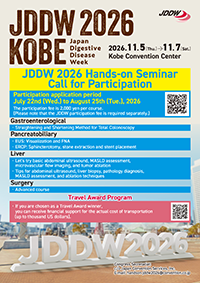
JDDW 2026 Hands-on Seminar Call for Participation
We will be conducting Hands-on Seminars at JDDW 2026.
Those who wish to participate, please fill in the necessary information and apply through the application button. The participation fee is 2,000 yen per course. (Please note that the JDDW participation fee is required separately.)
After the pre-registration, we will contact the registered e-mail address with the results by the end of September.around Thursday, October 15.
After registering for the JDDW 2026 main conference via the web, please proceed with the payment for the Hands-on Seminar registration fee separately.
Details regarding the procedure will be communicated individually to the applicants.
- *
- Please note that if the procedure and payment are not confirmed by the deadline, your application will be treated as canceled, and the next candidate will be selected as a replacement. Please understand this in advance.
Participation application period
July 22nd (Wed.) to August 25th (Tue.), 2026
「8. Hos Surgery 2 “Advanced course”」has reached capacity and is now closed for participation. However, applications are still being accepted for some courses.
Participation application period for hands-on seminar have been extended until September 15th (Tue.).
Participation application has closed.
We will contact the registered e-mail address with the results by around Thursday, October 15.
Regarding the Application
- Please select your desired course (1st to 2nd choice).
- To prevent missed opportunities, please refrain from canceling without notice.
- If you need to cancel, please make sure to contact the congress secretariat of JDDW 2026 by October 2nd (Fri.), 2026.
Gastroenterological
| Program Manager: | Toshio Uraoka | Department of Gastroenterology and Hepatology, Gunma University Graduate School of Medicine |
|---|---|---|
| Tadakazu Hisamatsu | Department of Gastroenterology and Hepatology, Kyorin University School of Medicine |
Gastroenterological Session Common
Colonoscopy should be a painless procedure for the patient. Excessive intestinal stretching is one reason for the pain during colonoscopy. Therefore, the straightening and shortening technique is the key to master a rapid and comfortable colonoscopy. Endoscopy relies heavily on one's skill, which also takes time to master. It is important to gain a lot of experience, but the fastest way to learn the technique is to receive direct instruction from experts. This hands-on seminar aims to help participants master the basics of colonoscopy intubation through training with emphasis on the straightening and shortening technique using a colon model.1. HOS Gastroenterological 1「Straightening and Shortening Method for Total Colonoscopy」
Capacity: 5 persons
Venue: Kobe International Conference Center, 5F 「504+505」
Overview
Participants will train on the straightening and shortening technique for a rapid and comfortable total colonoscopy, with the aim to master insertion up to the cecum within 5 minutes using a colon model.
Target participants [Beginner to intermediate level]
Program
Colonoscopy training using a colon model:
- Intubation method for colonoscopy using the straightening and shortening technique.
- Intubation up to the cecum within 5 minutes
| Coordinator: | Akiko Ohno | Department of Gastroenterology and Hepatology, Kyorin University School of Medicine |
|---|---|---|
| Instructor: | Masayoshi Fukuda | Fukuda Clinic |
| Yohei Minato | NTT Medical Center Tokyo, Department of Gastrointestinal Endoscopy | |
| Mitsunori Kusuhara | Department of Gastroenterology and Hepatology, Kyorin University School of Medicine | |
| Kazuya Takahashi | Division of Gastroenterology and Hepatology, Graduate School of Medical and Dental Sciences, Niigata University |
Application is now closed.

2. HOS Gastroenterological 2 「Straightening and Shortening Method for Total Colonoscopy」
Capacity: 5 persons
Venue: Kobe International Conference Center, 5F,「504+505」
Overview
Participants will train on the straightening and shortening technique for a rapid and comfortable total colonoscopy, with the aim to master insertion up to the cecum within 5 minutes using a colon model.
Target participants [Beginner to intermediate level]
Program
Colonoscopy training using a colon model:
- Intubation method for colonoscopy using the straightening and shortening technique.
- Intubation up to the cecum within 5 minutes
| Coordinator: | Chika Kusano | Department of Gastroenterology, Kitasato University School of Medicine |
|---|---|---|
| Instructor: | Yui Kudo | Kudo-Clinic |
| Chikamasa Ichita | Kitasato University School of Medicine, Department of Gastroenterology | |
| Shunichiro Ozawa | Department of Gastroenterology, Japan Community Healthcare Organization Yamanashi Hospital | |
| Kuniyo Gomi | Department of Gastroenterology, Kishiwada Tokushukai Hospital |
Application is now closed.
Pancreatobiliary
| Program Manager: | Yousuke Nakai | Department of Gastroenterology, Tokyo Women's Medical University |
|---|---|---|
| Hiroyuki Isayama | Department of Gastroenterology, Graduate School of Medicine, Juntendo University |
Pancreatobiliary Session Common
EUS and ERCP are two major diagnostic and therapeutic endoscopic procedures for pancreatobiliary diseases. To achieve high diagnostic yield by EUS-FNA, visualization using convex EUS is essential. Advanced interventional EUS such as drainage of pancreatic fluid collection and bile duct can be only performed after learning basic EUS and EUS-FNA.In ERCP, biliary cannulation and subsequent endoscopic sphincterotomy are the basics of various therapeutic ERCP to manage biliary strictures and stones. In the EUS session, trainees will learn the standard visualization of the pancreatobiliary anatomy by convex EUS, and basic techniques of EUS-FNA using phantom models. In the ERCP session, trainees will learn the basic process of ERCP; scope insertion, biliary cannulation, endoscopic sphincterotomy and subsequent treatment such as biliary stenting and stone extraction, using a dry ERCP model. All hands-on trainers are well experienced both in procedures and educations. In addition to novices, trainees with some experiences who seek to have practical advice from experts are also welcome.
3. HOS Pancreatobiliary 1 「EUS: Visualization and FNA」
Capacity: 4 persons
Venue: Kobe International Conference Center, 5F「502」
Target participants [Beginner]
Limited to doctors in facilities equipped with EUS systems.
Program
Basic convex EUS training
-Standard visualization
-FNA
| Coordinator: | Koji Matsuda | Department of Gastroenterology, National Hospital Organization Shizuoka Medical Center |
|---|---|---|
| Instructor: | Shunsuke Omoto | Department of Gastroenterology and Hepatology, Kindai University Faculty of Medicine |
| Nozomi Okuno | Department of Gastroenterology, Aichi Cancer Center | |
| Kosuke Okuwaki | Department of Gastroenterology, Kitasato University School of Medicine | |
| Masayuki Kato | Department of Endoscopy, The Jikei University School of Medicine | |
| Hideyuki Shiomi | Division of Hepatobiliary and Pancreatic Disease, Department of Gastroenterology, Hyogo Medical University | |
| Yuki Tanisaka | Department of Gastroenterology, Saitama Medical University International Medical Center | |
| Toshio Fujisawa | Department of Gastroenterology, Graduate School of Medicine, Juntendo University | |
| Kazuyuki Matsumoto | Department of Endoscopy, Okayama University Hospital |
Application is now closed.
4. HOS Pancreatobiliary 2「ERCP: Sphincterotomy, stone extraction and stent placement」
Capacity: 4 persons
Venue: Kobe International Conference Center, 5F,「502」
Target participants【Beginner】
Program
Basic ERCP training
-Biliary cannulation, EST, stent placement
-Stone extraction
| Coordinator: | Yousuke Nakai | Department of Gastroenterology, Tokyo Women's Medical University |
|---|---|---|
| Instructor: | Eisuke Iwasaki | Department of Internal Medicine, Tokai University School of Medicine |
| Naminatsu Takahara | Department of Gastroenterology, The University of Tokyo Hospital | |
| Ryunosuke Hakuta | Department of Internal Medicine, Institute of Gastroenterology Tokyo Women's Medical University | |
| Yoshihide Kanno | Department of Gastroenterology and Hepatology, Sendai City Medical Center Sendai Open Hospital | |
| Takayoshi Tsuchiya | Department of Gastroenterology and Hepatology, Tokyo Medical University | |
| Kazunari Nakahara | Department of Gastroenterology, St. Marianna University School of Medicine | |
| Nao Fujimori | Department of Medicine and Bioregulatory Science, Graduate School of Medical Sciences, Kyushu University | |
| Suguru Mizuno | Department of Gastroenterology and Hepatology, Saitama Medical University Hospital |
Application is now closed.
Liver
| Program Manager: | Yoichi Hiasa | Department of Gastroenterology and Metabology, Ehime University Graduate School of Medicine |
|---|---|---|
| Hidekatsu Kuroda | Division of Gastroenterology and Hepatology, Iwate Medical University |
Liver Session Common
We are pleased to announce the upcoming hands-on seminar aimed at mastering practical skills in abdominal ultrasound screening examinations, liver biopsy, and needle aspiration and ablation therapy for liver tumors using abdominal ultrasound techniques.This year, we will also focus on fat quantification and liver stiffness measurement necessary for MASLD (metabolic dysfunction-associated steatotic liver disease) diagnosis, as well as visualization of microvascular blood flow using the latest ultrasound technology.
In individual booths, the first half will focus primarily on abdominal ultrasound screening and fat quantification/liver stiffness measurement, while the latter half will involve practical training in ultrasound-guided radiofrequency ablation therapy.
Additionally, mini-lectures and live demonstrations will be held simultaneously on a mini-stage. Participants can freely choose the content they wish to learn.
Those who have always felt unsure about abdominal ultrasound, those who wish to master ultrasound screening, and those who want to learn new evaluation methods for MASLD diagnosis are all warmly welcomed.
With four booths and two instructors per booth, participants can learn at their own pace. We look forward to your application.
5. HOS Liver 1「Let's try basic abdominal ultrasound, MASLD assessment, microvascular flow imaging, and tumor ablation.」
Capacity: Please contact us directly.Capacity: Please contact us directly.
Venue: Kobe International Conference Center, 5F,「501」
Overview
From basic abdominal ultrasound examination techniques to fat quantification and liver stiffness measurement for MASLD diagnosis, visualization of microvascular blood flow using the latest ultrasound technology, and ablation, participants will gain hands-on experience and master these skills.
Target participants [Beginner to intermediate level]
Program
① Abdominal ultrasound: Basics and practice
② Fat quantification and liver stiffness measurement for MASLD diagnosis (FibroScan/Elastography)
③ Advanced microvascular flow imaging
④ Basic ablation techniques
Includes hands-on experience with FibroScan.
| Coordinator: | Yasunori Minami | Department of Gastroenterology and Hepatology, Kindai University Faculty of Medicine |
|---|---|---|
| Hayato Hikita | Department of Gastroenterology and Hepatology, The University of Osaka, Graduate School of Medicine | |
| Instructor: | Hidekatsu Kuroda | Division of Gastroenterology and Hepatology, Iwate Medical University |
| Masashi Hirooka | Total Medical Support Center, Ehime University Hospital | |
| Tamami Abe | Iwate Medical University, Department of Gastroenterology and Hepatology, Division of Internal Medicine | |
| Kumiko Shirai | Department of Gastroenterology and Hepatology, The University of Osaka | |
| Hironori Ochi | Matsuyama Red Cross Hospital | |
| Hiroko Iijima | Division of Hepatobiliary and Pancreatic Diseases, Department of Gastroenterology, Hyogo Medical University | |
| Takashi Nishimura | Division of Hepatobiliary and Pancreatic disease, Department of Gastroenterology, Hyogo Medical University | |
| Yukinobu Watanabe | Nihon University School of Medicine, Department of Gastroenterology and Hepatology | |
| Yusuke Komeda | Department of Gastroenterology, Nara Medical University | |
| Mina Komuta | Department of Pathology, International University of Health and Welfare, School of Medicine | |
| (Course Supporter) | Tatsuya Yamauchi | Department of Gastroenterology and Metabology, Ehime University Graduate School of Medicine |
| Kentaro Yasuda | Department of Gastroenterology, The University of Osaka | |
| Tatsuhiro Hirano | Department of Gastroenterology, Hyogo Medical University Hospital |
Application is now closed.
6. HOS Liver 2「Tips for abdominal ultrasound, liver biopsy, pathology diagnosis, MASLD assessment, and ablation techniques.」
Capacity: Please contact us directly.Capacity: Please contact us directly.
Venue: Kobe International Conference Center, 5F,「501」
Overview
From basic abdominal ultrasound techniques to tumor biopsy and radiofrequency ablation therapy for liver tumors, liver pathology diagnosis, fat and liver stiffness measurement for MASLD diagnosis, and specimen handling and observation of pathological findings, participants will gain hands-on experience and master these skills.
Target participants【Beginner to intermediate level】
Program
① Abdominal ultrasound: Basics and practice
② Liver puncture and ablation techniques, and precautions
③ Handling liver tumor biopsy specimens and observation of pathological findings
④ Fat and liver stiffness measurement for MASLD diagnosis
Includes hands-on experience with FibroScan.
| Coordinator: | Yasunori Minami | Department of Gastroenterology and Hepatology, Kindai University Faculty of Medicine |
|---|---|---|
| Hayato Hikita | Department of Gastroenterology and Hepatology, The University of Osaka, Graduate School of Medicine | |
| Instructor: | Hidekatsu Kuroda | Division of Gastroenterology and Hepatology, Iwate Medical University |
| Masashi Hirooka | Total Medical Support Center, Ehime University Hospital | |
| Tamami Abe | Iwate Medical University, Department of Gastroenterology and Hepatology, Division of Internal Medicine | |
| Kumiko Shirai | Department of Gastroenterology and Hepatology, The University of Osaka | |
| Hironori Ochi | Matsuyama Red Cross Hospital | |
| Masahiro Ogawa | Division of Gastroenterology and Hepatology, Department of Internal Medicine, Nihon University School of Medicine | |
| Naoki Matsumoto | Division of Gastroenterology and Hepatology, Department of Medicine, Nihon University School of Medicine | |
| Yoshinari Asaoka | Department of Medicine, Teikyo University School of Medicine | |
| Yoshiko Nakamura | Department of Gastroenterology and Metabology, Ehime University Graduate School of Medicine | |
| Akihiro Funaoka | Gastroenterological Center, Yokohama City University Medical Center | |
| Reiichiro Kondo | Department of Pathology, Kurume University School of Medicine | |
| (Course Supporter) | Seiya Sudo | Department of Gastroenterology and Metabology, Ehime University Graduate School of Medicine |
| Yuichi Takeishi | Division of Gastroenterology and Hepatology, Department of Medicine, Nihon University School of Medicine | |
| Yoshihiro Toda | Department of Gastroenterology and Hepatology, Iwate Medical University |
Application is now closed.
Surgery
| Program Manager: | Masafumi Inomata | Department of Gastroenterological Surgery, Oita University |
|---|---|---|
| Chie Tanaka | Department of Gastroenterological Surgery, Nagoya University Graduate School of Medicine |
Advanced Course
Are you hesitant to adopt techniques such as laparoscopic lateral pelvic lymph node dissection or intracorporeal anastomosis during colectomy due to uncertainty about the key tips and potential pitfalls?In this hands-on seminar, participants will receive guidance from experts in colorectal surgery and will have the opportunity to practice lateral pelvic lymph node dissection using specialized models, as well as intracorporeal anastomosis using intestinal models.
We hope this program will contribute to a deeper understanding of surgical techniques and help enhance your technical skills. We look forward to your participation.
7. HOS Surgery 1「Basic course」
Not available
8. HOS Surgery 2「Advanced course」
Capacity: 1 to 2 persons
Venue: Kobe International Conference Center, 5F,「501」
Overview
①Intracorporeal anastomosis
Intracorporeal anastomosis training using a dry box and intestinal model.
②Laparoscopic lateral lymph node dissection for rectal cancer using a pelvic model.
Target participants [Intermediate level]
Program
Intracorporeal anastomosis for colectomy
Laparoscopic lateral lymph node dissection using a pelvic model
| Coordinator: | Jun Watanabe | Department of Colorectal Surgery, Kansai Medical University |
|---|---|---|
| Instructor: | Masanori Kotake | Koseiren Takaoka Hospital, Department of Surgery |
| Takahiro Yamanashi | Department of Lower Gastrointestinal Surgery, Kitasato University School of Medicine | |
| Tomohiro Arita | Division of Digestive Surgery, Department of Surgery, Kyoto Prefectural University of Medicine | |
| Atsushi Hamabe | Department of Gastroenterological Surgery, Graduate School of Medicine, The University of Osaka | |
| Masatsune Shibutani | Department of Gastroenterological Surgery, Osaka Metropolitan University |
Application is now closed.